
"Keep on asking, and you will receive what you ask for. Keep on seeking, and you will find. Keep on knocking, and the door will be opened to you.”
Matthew 7:7
While watching an interview featuring Tony Robbins and Joe Berlinger, a movie director who has recently produced a full length feature film documenting one of Robbins’ multi-day seminars, I was reminded of one of the key secrets to finding financial freedom. After pitching their movie, several people in the audience were given the opportunity to question Tony or Berlinger. In an answer to one of these questions Tony observed, “People over estimate what they can accomplish in a year, but they under estimate what they can accomplish in ten years.”
On numerous occasions, I have observed that the poor think week to week or even day to day. The middle class just wants to cover the monthly payments necessary to maintain their lifestyle. The rich are making plans that cover years. The very rich think in terms of decades.
For most of us, who do not win the lottery or have an indulgent rich sugar daddy, achieving financial freedom requires years of focused concentrated effort. Based on my personal experience, achieving a major financial goal will take about ten years of consistent work.
I paid off a thirty year mortgage in about 9 ½ years. I am afraid of debt. I wanted to get out of debt as quickly as possible. I was willing to make sacrifices in order to achieve this goal, but it was more than that. In my mind I was not a debtor. This was simply unacceptable. For eight years I drove a 1966 Volkswagen without air conditioning in order to make extra payments to principal. I maintained a spreadsheet detailing every payment that I made. As I made those payments, I watched months roll off the back side of that loan ultimately saving me well over $100,000. Every time I made an extra payment, I celebrated. When I made my last mortgage payment, I received the largest raise of my entire life. What could you do with an extra $1,000 every month?
About the time I turned 50, I started thinking about investing for retirement. Given that I was the totally debt free owner of a house and had some money in the bank and in my version of a 401(k) I was just about where Stanley and Danko, authors of The Millionaire Next Door would expect to find someone of my age and income. Then I went into savings overdrive. I gradually bumped up my contributions to the 401(k) to 14%, just below the recommended 15%. It was a mistake to reach that level so late in life, but I was suspicious after the Clinton administration “borrowed,” confiscated (?) all the G fund money in Government retirement accounts during one of the periodic Federal shutdowns. Of course Clinton returned my money, but after that, I never completely trusted that account. Instead, I went wild with my taxable investment account. On many months, my contributions to my taxable retirement nest egg were approaching 30% of my take home pay. It is amazing what can be accomplished if you don’t have a mortgage payment, a car payment, or carry a balance on a credit card. Over the course of ten years, I increased the liquid portion of my net worth by over 600%. At this point I was close to double the net worth expected for someone of my age and income.
I remember with some pleasure when during one of my annual performance evaluations my boss asked that silly question, “Where do you see yourself in five years?”
My answer, “Retired.”
You can do it. Set yourself a big goal. Then start to work. Record your progress. Celebrate your victories. Refuse to accept anything less than excellence in pursuing your dream. The day will come when other people will tell you that you are lucky. Just smile and agree with their evaluation of your success, reminding yourself that God does play a role in our lives.
Colossians 3:23
Whatever you do, work at it with all your heart, as working for the Lord, not for men.
Tuesday, July 19, 2016

Sunday, July 17, 2016
Simple Questions
It is hard to give simple answers to what I perceive as a complex question. Recently I was asked what sort of percentage of her take home pay should a recent college graduate budget for her rent. Of course I had a number in my head, but without knowing any other details any counsel I could give would likely be bad counsel. Instead, I offered advice I consider critical in all situations. Pay yourself first. Put 10% of you take home pay into savings before budgeting the first penny. Avoid debt like the plague. If you consistently spend less than you make over a long period of time, you will find financial freedom.
Dave Ramsey recommends 25% as a target allocation for rent. I would be willing to go higher, perhaps 30% or even 33% in some instances. But it all depends. If you are living in a high rent area, like San Francisco, you might not want to live in an apartment or even be able to find an apartment that only consumes 30% of your take home pay. In some rural settings, 25% might provide an excessively opulent house better suited for a family.
If your parents gave you a good car, you will have more money available to live in a better neighborhood. If you have a car payment that is consuming 25% of your take home pay, it is likely you won’t be able to afford 25% for rent.
If you are a young single woman, you might be more interested in a safe apartment complex than a young man with nothing worth stealing. This would be a greater concern in a city than in a small town or a rural setting, but it is something that should be considered before making a decision.
Your choice of rental property will also determine the time and cost of your commute. When I lived in the Washington D.C. area, the cheapest acceptable apartment was about 18 miles away from my place of work. At the height of rush hour, it could take close to an hour to cover that miserably short distance. Using Metro and the bus took even longer.
There are other small concerns. Does the cost of rent include any utilities? Almost all apartments include the cost of water. If the complex provides an exercise room and a pool, how much is that worth to your quality of life?
Your budget will also reflect your values and your tastes. When I was young and single, my clothing expense was zero during most months. On the other hand, most young women would likely want to budget a percentage of their take home pay for clothing.
In the end, creating a budget seems much like squeezing a water balloon. What goes out of one end of the balloon will inflate the other end of the balloon. As long as don’t try to put $2,600 dollars worth of monthly expenses into a $2,500 balloon you will be OK. Your goal is to spend less than you take home after budgeting for all regular monthly expenses and allowing for all irregular expenses, such as insurance and taxes.
Monday, July 11, 2016
As For Me And My House!
Recently I listened to one of Rabbi Daniel Lapin’s podcasts. While I strongly recommend his book, Thou Shall Prosper, a study of personal finance from a traditional Jewish viewpoint, I seldom listen to his radio show as he tends to ramble and head down rabbit paths that have nothing to do with the topic of the discussion. During this broadcast, he noted that in his experience, the single most important variable that leads to wealth is membership in a family that has enjoyed reasonably healthy intact marriages for three generations. As I think about the people I have met over the course of my life, I can’t disagree with the good Rabbi. In my experience, people who talk about their grandparents and parents with respect, who retell family legends, myths, and stories that support financially responsible behavior tend to enjoy better outcomes in life.
A child born out of wedlock is 5 times more likely to grow up in poverty than a child raised in an intact family. Such a child is also more likely to do poorly in school, engage in criminal behavior, become a substance abuser, and have children out of wedlock. While there are exceptions, such as Doctor Ben Carson, the statistics are simply overwhelming. It is pretty clear that children that grow up in a traditional family enjoy a huge advantage.
While my family was not perfect, I was blessed with a third generation terror of debt. My grandparents were one of only two families in their section of Yankton County, SD that managed to hold on to their farm throughout the Great Depression. Terrified of debt, my grandmother insisted that my grandfather pay down the mortgage on the farm before buying any more land during the boom years of the twenties. My grandfather managed to give each of his four children a farm before he died. He believed that if they owned a farm, free and clear of debt, they could care for their families no matter what happened. As a child, I was told these sorts of stories over and over again. Back in the early sixties, credit card companies would send unsolicited cards to prospective customers. When my parents received one of these things in the mail, I was given a pair of scissors along with instructions to destroy that evil dangerous object. I didn’t get a credit card until I was 35 years old. By that time living without a credit card in the Washington, DC area was simply impossible.
Should it surprise anyone that I frequently write rants denouncing the evils of debt? It just never occurred to me to borrow money to buy a car or even pay for tuition for my second degree. Only in the last ten years or so have I learned that Warren Buffett teaches young people that the most important single thing they can do to reach financial freedom is avoid debt, particularly at an early age.
In many ways we become who we believe we will become; who we are told we will become. While Davy Crockett did not kill 200 Mexicans with the butt end of his rifle during the battle for the Alamo, believing that this is so will make a young Texan a braver solider and a better man. If you have the benefit of a stable supportive family that is a wonderful blessing, but if you don’t this very day you can take a stand. Sonya Carson made such a decision. She worked two or three jobs to support her family. Her faith gave her the wisdom and strength to change her family tree. In spite of growing up in a single parent home in the inner city, Doctor Carson turned out OK. I also expect his mother’s gift to her family tree will continue to provide blessings to our country for many generations to come.
Joshua 24:14-15King James Version (KJV)
14 Now therefore fear the LORD, and serve him in sincerity and in truth: and put away the gods which your fathers served on the other side of the flood, and in Egypt; and serve ye the LORD.
15 And if it seem evil unto you to serve the LORD, choose you this day whom ye will serve; whether the gods which your fathers served that were on the other side of the flood, or the gods of the Amorites, in whose land ye dwell: but as for me and my house, we will serve the LORD.
15 And if it seem evil unto you to serve the LORD, choose you this day whom ye will serve; whether the gods which your fathers served that were on the other side of the flood, or the gods of the Amorites, in whose land ye dwell: but as for me and my house, we will serve the LORD.
Friday, July 8, 2016
What do You Really Want?

Wednesday, July 6, 2016
An Age Appropriate Balance
The subject keeps coming up in conversations so pardon me if this is something you have already seen more than one time. People frequently ask me what investments they should buy. Of course, since my crystal ball didn’t come with a set of instructions, I won’t suggest what to buy with specific recommendations, but I will suggest how to buy and a few rules of thumb to keep you out of trouble.
The old rule of thumb was your age in bonds. Bonds are here defined as cash, savings accounts, certificates of deposit, money market funds, bonds, and bond mutual funds. Equities, the other half of the equation would consists of individual shares including common stock, preferred stock, Real Estate Investment Trusts, Master Limited Partnerships (oil and gas pipelines) and mutual funds containing various forms of these equities.
Hence at age 30, an investor should have 30% in bonds and 70% in stocks.
At age 70, an investor should have 70% in bonds and 30% in stocks. There are two reasons that this was accepted common wisdom. When you are young, you are playing with small amounts of money over a very long time period—the rest of your working life and beyond. When you are old you are (hopefully) dealing with large sums of money over a limited time—the rest of your life. Since you can’t easily go back to work at age 80 and start over, you can’t afford to make a big mistake at such an advanced age. The second reason is—reason. Our decision making capacity peaks around age 55, then we start downhill. Following the wretched stagflation of the 1970s, the conventional wisdom was changed to allow for the threat of inflation. First it was suggested your age less 10% in bonds. Then it went to your age less 15% in bonds during the go-go years leading up to the slow motion train wreck of 2006 to 2009. Using this logic, at age 30 an investor should have 15% in bonds and 85% in stocks.
At age 70, an investor should have 55% in bonds and 45% in stock. Since 2008, convention wisdom has been creeping back to something closer to the original suggestion of your age in bonds. If you stay within 5% or 10% of the old conventional wisdom, chances are you will be alright. What about gold? Is it money or is it a stock? I change my mind on this question from time to time. Right now I consider gold money since the Chinese and the Indians consider it money. I still think the best advice I have heard on gold suggests, “Put 5% of your portfolio in gold (shares in GLD is the simplest method). Then pray every day that the value of your gold declines. If the value of your gold is declining, it is likely that the value of everything else is going up.” I think that 5% is a little on the high side, but I agree that every portfolio should contain some precious metal as insurance against a market collapse. The changing value of gold is a measure of fear in the marketplace. When everyone is optimistic and happy, the value of gold drops. When we worry about Brexit or are reacting to some other threat to the economy the price of gold goes up. There are other considerations. What kind of bonds? What kind of stocks? While this question is beyond the scope of a single blog post, more in conservative positions and less in risky positions when you are old and the reverse when you are young. Hence a young person can afford to have more in small cap stocks, technologies, and developing markets. The old timer should have the bulk of his equity holdings in stable large cap stocks from the developed world along with shares in regulated utilities and consumer non-cyclicals that sell things people always need, like food, soap, and toilet paper. The same logic applies to bonds. The safest are Treasury bonds and similar “full faith and credit” instruments issued by the Federal Government. Investment grade bonds from companies like Chevron, General Electric, and regulated utilities would come next. Junk bonds, euphemistically termed “high yield” are risky, but if you buy one from a company that works itself out of trouble, you can make a lot of money. Of course, if the company defaults, all you are left with is a worthless piece of paper. Finally, let me mention diversification. If you have more than 7% to 10% of your net worth in any single company or even in a few closely related companies in the same sector you are asking for trouble. British Petroleum was one of the best managed, most profitable companies in the world, until a black oily swan flew over a drilling platform in the Gulf of Mexico. Then British Petroleum lost half its value in a couple of weeks. People, who held less than 10% in dotcoms in the years before 2000, didn’t make as much money as their friends who believed the most dangerous words in investing, “This time it’s different,” but then in 2000 when they watched their dotcoms fade into the sunset, they just shrugged their shoulders and moved on. Those who believed that this time it was different lost almost everything. If the foundation of your investment portfolio contains shares in several low cost index funds representing different types of investment vehicles, you should be sufficiently diversified. Good luck. And Please! Let’s be careful out there.
At age 70, an investor should have 70% in bonds and 30% in stocks. There are two reasons that this was accepted common wisdom. When you are young, you are playing with small amounts of money over a very long time period—the rest of your working life and beyond. When you are old you are (hopefully) dealing with large sums of money over a limited time—the rest of your life. Since you can’t easily go back to work at age 80 and start over, you can’t afford to make a big mistake at such an advanced age. The second reason is—reason. Our decision making capacity peaks around age 55, then we start downhill. Following the wretched stagflation of the 1970s, the conventional wisdom was changed to allow for the threat of inflation. First it was suggested your age less 10% in bonds. Then it went to your age less 15% in bonds during the go-go years leading up to the slow motion train wreck of 2006 to 2009. Using this logic, at age 30 an investor should have 15% in bonds and 85% in stocks.
At age 70, an investor should have 55% in bonds and 45% in stock. Since 2008, convention wisdom has been creeping back to something closer to the original suggestion of your age in bonds. If you stay within 5% or 10% of the old conventional wisdom, chances are you will be alright. What about gold? Is it money or is it a stock? I change my mind on this question from time to time. Right now I consider gold money since the Chinese and the Indians consider it money. I still think the best advice I have heard on gold suggests, “Put 5% of your portfolio in gold (shares in GLD is the simplest method). Then pray every day that the value of your gold declines. If the value of your gold is declining, it is likely that the value of everything else is going up.” I think that 5% is a little on the high side, but I agree that every portfolio should contain some precious metal as insurance against a market collapse. The changing value of gold is a measure of fear in the marketplace. When everyone is optimistic and happy, the value of gold drops. When we worry about Brexit or are reacting to some other threat to the economy the price of gold goes up. There are other considerations. What kind of bonds? What kind of stocks? While this question is beyond the scope of a single blog post, more in conservative positions and less in risky positions when you are old and the reverse when you are young. Hence a young person can afford to have more in small cap stocks, technologies, and developing markets. The old timer should have the bulk of his equity holdings in stable large cap stocks from the developed world along with shares in regulated utilities and consumer non-cyclicals that sell things people always need, like food, soap, and toilet paper. The same logic applies to bonds. The safest are Treasury bonds and similar “full faith and credit” instruments issued by the Federal Government. Investment grade bonds from companies like Chevron, General Electric, and regulated utilities would come next. Junk bonds, euphemistically termed “high yield” are risky, but if you buy one from a company that works itself out of trouble, you can make a lot of money. Of course, if the company defaults, all you are left with is a worthless piece of paper. Finally, let me mention diversification. If you have more than 7% to 10% of your net worth in any single company or even in a few closely related companies in the same sector you are asking for trouble. British Petroleum was one of the best managed, most profitable companies in the world, until a black oily swan flew over a drilling platform in the Gulf of Mexico. Then British Petroleum lost half its value in a couple of weeks. People, who held less than 10% in dotcoms in the years before 2000, didn’t make as much money as their friends who believed the most dangerous words in investing, “This time it’s different,” but then in 2000 when they watched their dotcoms fade into the sunset, they just shrugged their shoulders and moved on. Those who believed that this time it was different lost almost everything. If the foundation of your investment portfolio contains shares in several low cost index funds representing different types of investment vehicles, you should be sufficiently diversified. Good luck. And Please! Let’s be careful out there.
Sunday, July 3, 2016
Reflections on Brexit
The recent Brexit commotion has reinforced many of my investment prejudices. It has been reported that the world’s stock markets lost $3 trillion then made most of it back—all in the space of a few days. Once J.P. Morgan was asked what he expected the stock market to do over then next few years, his answer, “Fluctuate.”
That is the only thing that we know for certain. We don’t know if the market will go up or down. We don’t know if individual stocks will go up or down. However, if we diversify and hope for the best, Siegel’s constant tells us that over any sufficiently long period of time we can expect a 7% return on investment after taxes and inflation. The typical thirty five to forty years of work before retirement is an example of a sufficiently long period of time.
Don’t panic. The world ends every twelve years or so. Then the market will come back. Will it continue to follow this pattern forever? Who knows? I don’t, but over 200 years of data makes me hopeful. If we experience a nuclear war or a revolution, I doubt that the condition of my investments will be my first concern.
In the aftermath of Brexit, one of my stocks, Hong Kong Shanghai Bank based in England took a pretty nasty hit, although it is starting to recover. However gold jumped quite nicely and my American dollars increased in value. Diversify. Diversify. Diversify. As Solomon observed, “Give portions to seven, yes, to eight because you do not know what disaster may come upon the land.”
If you are a trader, you are not playing my game. I am trying to follow Richard Russell’s advice, “Don’t need the market.” Try to make decisions based on the “Prudent Man Rule.” Although this court case is based on the fiduciary nature of the trustee relationship, it is pretty sound advice for any investor. First consider your needs for the future. Then balance your desire for capital gains with your need for income. Time and dividends are your friends. If you can live without the money you have placed in a diverse selection of conservative dividend paying stocks and let the magic of compound interest work in your favor in some instances you will find that your money has doubled even if the price of the underlying shares haven’t measurably increased. Using a free Dividend ReInvestment Program (DRIP) your dividends will automatically buy more shares when the price is low and fewer shares when the price is high. All the time those new shares are generating more dividends to buy additional shares. From time to time over the course of many years, Warren Buffett has bought shares in Coca Cola, but he has never sold any of those shares. Find well managed corporations with wide moats that have a record of increasing their dividends over time or just buy shares in a low cost dividend index fund.
Don’t make hasty decisions. Solomon observes, “The plans of the diligent lead to profit as surely as hast leads to poverty.” I have learned that a hasty decision to buy or sell is often a bad decision. Yes, I do lose some money by missing the tops and the bottoms, but pointing that out assumes that you can always pick the absolute top and the absolute bottom. Good luck with that assumption.
In order to make diligent decisions, we need good advice and good advisors. Solomon also said, “In a multitude of counselors there is wisdom.” Consider news reports on something as trivial as a football game. If you read two reports on the same game in different newspapers, the only thing that writers might agree upon is the final score. However, if you read a half-a-dozen reports on the same game it is likely that you will get a pretty clear and balanced picture of the truth. The investment press is full of opinions, some honest, some compromised by a conflict of interest. However, if you listen carefully to this multitude of counselors you may be surprised how much wisdom you will gain.
Balance. Balance and rebalance. Make certain you have balanced your equities with bonds, CDs, and cash. The Brexit dip was over before it gave me the opportunity to buy. I had made the decision to start buying after a 15% drop. I had the free cash to take advantage of such a situation. In 2008 I bought all the way down. It is very scary to lose money in the market, buy more shares, and then lose more money. However, in the end it turned out well. The last nine months of 2009 was a really good time for the market. Decide on an age appropriate balance of equities and near cash that allows you to sleep soundly on most nights. Then stick with that balance. When the market goes up, sell something. Then put the profits in bonds, a money market fund, or even an old fashioned savings account. When the market drops, start buying equities with that money you stashed away for just such an opportunity. Most investors do the opposite. They buy when the market is near its peak. Then they panic and sell when the market is near the bottom, guaranteeing they lock in their losses.
I continue to believe that the market is overvalued. However, I don’t know what the actions of the Federal Reserve or the British voters might have on the future of my retirement portfolio, so I remain in the market in good times and in bad. I have found that is the best I can do.
Wednesday, June 29, 2016
Soft Tyranny
“Thus, after having thus successively taken each member of the community in its powerful grasp and fashioned him at will, the supreme power then extends its arm over the whole community. It covers the surface of society with a network of small complicated rules, minute and uniform, through which the most original minds and the most energetic characters cannot penetrate, to rise above the crowd. The will of man is not shattered, but softened, bent, and guided; men are seldom forced by it to act, but they are constantly restrained from acting. Such a power does not destroy, but it prevents existence; it does not tyrannize, but it compresses, enervates, extinguishes, and stupefies a people, till each nation is reduced to nothing better than a flock of timid and industrious animals, of which the government is the shepherd.” Yes, the powers that be will take care of their own; the public sector will protect their employees until bankruptcy overtakes a city or a nation; the corporations will protect the interests of the unusually valuable gold collar employees, until it is no longer in their interest to continue this practice.
Don’t believe me, just ask my generation about their financial prospects in retirement.
Remember the national debt was doubled to buy that little bump at the end of the graph.
Only three things can be done with debt, individual debt, corporate debt, municipal debt, or sovereign debt. It can be repaid. This is often painful, difficult, and tends to slow down the economy. The debtor can default or declare bankruptcy, or if the debtor nation controls the printing presses, the debt can just be inflated out of existence. The last two options tend to produce economic cataclysms accompanied by blood in the street. We are like a family with parents who have lost their jobs using their credit cards to maintain their current lifestyle pretending that everything is OK.
Corporations do not pay taxes, the salaries of their employees, or the costs of regulatory compliance. All these costs are paid by you, their customers. If you are unwilling or unable to pay these costs, the corporation moves their operations to another country or shuts them down.
Governments and the banks can create money, but they can’t create wealth. No matter how well intentioned or efficient the program, Governments ultimately consume wealth through the entropy generated by the costs of administrative overhead or through the redistribution of wealth that is then consumed rather than invested to create more wealth.
Wealth is created by ingenuity and hard work—Your ingenuity and hard work.
THEY want docile debt slaves and tax donkeys. They don’t want independent free men and women living the life they choose. Look at the evidence. Who benefits from student loans? The schools get their money up front, guaranteed, whether or not the student ever finds a job in her field or even graduates. The banks get their money from Federal guarantees and loans that can’t be discharged in bankruptcy.
Over a trillion dollars a year is spent on advertising intent on convincing you that you can’t live without borrowing money to buy something you don’t need to impress people you don’t know. Why do for profit corporations spend all that money? It works! The average household credit card debt is $15,762. The only kind of debt that is more toxic than credit card debt are loans taken from payday lenders, title lenders, or criminal loan sharks.
Taxes? This year tax freedom day was April 24. If you are an average American you are working 114 days a year for the government. In retirement, I do better. Taxes are still my largest single expense—By Far—but I am receiving a FERS pension and 2/3 of the cost of my health insurance. If you are still working to help pay for these benefits, I thank you. I am also receiving Medicare and my wife is taking early Social Security, but we paid for those two programs. That’s our money.
Sometimes this job gets frustrating. How many times or ways can I say, “Avoid debt like the plague. Spend less than you make. Put the surplus in an insured savings account until you have built up a respectable emergency fund. Pay down your debts in a systematic and ruthless war. Then put the surplus in a mix of low cost index funds and some conservative dividend paying stocks. If you do these things you will be alright.”
Look at that graph again. It is getting harder for the average American high school graduate (or dropout) without any particular skill to make enough to support a family, but it is still possible for them to find financial freedom. It has been demonstrated that a family making $60,000 a year without ever getting a single raise or promotion can still retire with a million dollars in savings.
However, no matter what promises THEY make, it is up to you to make something out of your life. We don’t have any control over the cards life shuffles our way, but we are darn sure responsible for how we play our hand. No matter how bad things are, if you can read these words and understand them, there is something you to make your financial life better. Just do it. Do it today.
Yes, the powers that be will take care of their own; the public sector will protect their employees until bankruptcy overtakes a city or a nation; the corporations will protect the interests of the unusually valuable gold collar employees, until it is no longer in their interest to continue this practice.
Don’t believe me, just ask my generation about their financial prospects in retirement.
Remember the national debt was doubled to buy that little bump at the end of the graph.
Only three things can be done with debt, individual debt, corporate debt, municipal debt, or sovereign debt. It can be repaid. This is often painful, difficult, and tends to slow down the economy. The debtor can default or declare bankruptcy, or if the debtor nation controls the printing presses, the debt can just be inflated out of existence. The last two options tend to produce economic cataclysms accompanied by blood in the street. We are like a family with parents who have lost their jobs using their credit cards to maintain their current lifestyle pretending that everything is OK.
Corporations do not pay taxes, the salaries of their employees, or the costs of regulatory compliance. All these costs are paid by you, their customers. If you are unwilling or unable to pay these costs, the corporation moves their operations to another country or shuts them down.
Governments and the banks can create money, but they can’t create wealth. No matter how well intentioned or efficient the program, Governments ultimately consume wealth through the entropy generated by the costs of administrative overhead or through the redistribution of wealth that is then consumed rather than invested to create more wealth.
Wealth is created by ingenuity and hard work—Your ingenuity and hard work.
THEY want docile debt slaves and tax donkeys. They don’t want independent free men and women living the life they choose. Look at the evidence. Who benefits from student loans? The schools get their money up front, guaranteed, whether or not the student ever finds a job in her field or even graduates. The banks get their money from Federal guarantees and loans that can’t be discharged in bankruptcy.
Over a trillion dollars a year is spent on advertising intent on convincing you that you can’t live without borrowing money to buy something you don’t need to impress people you don’t know. Why do for profit corporations spend all that money? It works! The average household credit card debt is $15,762. The only kind of debt that is more toxic than credit card debt are loans taken from payday lenders, title lenders, or criminal loan sharks.
Taxes? This year tax freedom day was April 24. If you are an average American you are working 114 days a year for the government. In retirement, I do better. Taxes are still my largest single expense—By Far—but I am receiving a FERS pension and 2/3 of the cost of my health insurance. If you are still working to help pay for these benefits, I thank you. I am also receiving Medicare and my wife is taking early Social Security, but we paid for those two programs. That’s our money.
Sometimes this job gets frustrating. How many times or ways can I say, “Avoid debt like the plague. Spend less than you make. Put the surplus in an insured savings account until you have built up a respectable emergency fund. Pay down your debts in a systematic and ruthless war. Then put the surplus in a mix of low cost index funds and some conservative dividend paying stocks. If you do these things you will be alright.”
Look at that graph again. It is getting harder for the average American high school graduate (or dropout) without any particular skill to make enough to support a family, but it is still possible for them to find financial freedom. It has been demonstrated that a family making $60,000 a year without ever getting a single raise or promotion can still retire with a million dollars in savings.
However, no matter what promises THEY make, it is up to you to make something out of your life. We don’t have any control over the cards life shuffles our way, but we are darn sure responsible for how we play our hand. No matter how bad things are, if you can read these words and understand them, there is something you to make your financial life better. Just do it. Do it today.
Alexis de Tocqueville
Almost 200 years ago the historian and political thinker Alexis de Tocqueville first wrote about what has come to be called “soft tyranny” or “soft despotism.” As a democratically elected government becomes more intrusive, controlling greater portions of our daily lives, not with an iron fist, but as a strict school master, our freedom of thought and action is still just as curtailed. If you think that the actions of the political élites, their allies in money center banks and multinational corporations have your interests at heart, take a look at this graph.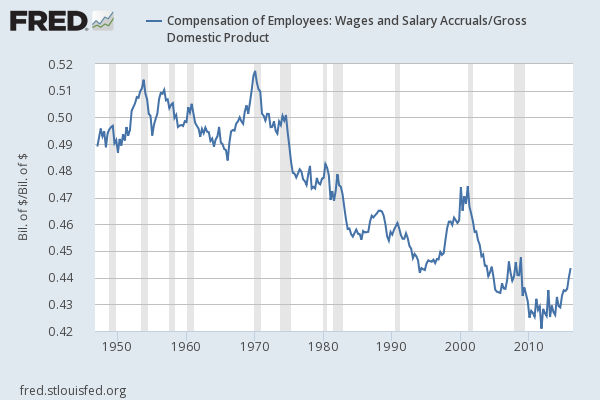
Subscribe to:
Posts (Atom)